


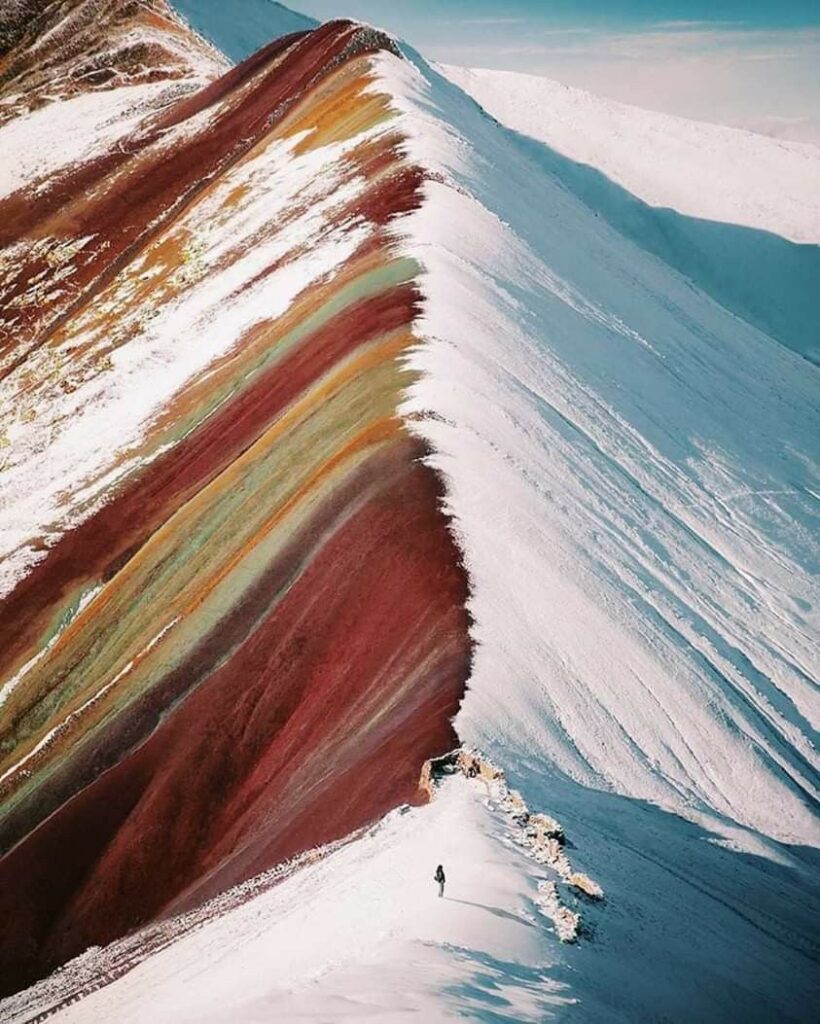
There are places in the world where nature seems to have forgotten the rules. The Peruvian Andes are one of those places. At over 4,000 meters above sea level, in the heights surrounding Cusco, three mountains display a palette of colors so intense and improbable that many travelers arrive convinced that the photographs are edited. They are not. The colors of Vinicunca, Palccoyo, and Pallay Puncho are completely real, and understanding why they exist makes seeing them in person even more impressive.
Why these colors exist: the geology behind the spectacle
The scientific explanation does not take away the magic — it adds to it. For millions of years, the Andes accumulated layers of mineral sediments from different origins: red clays rich in oxidized iron, yellow sulfur, copper in green and turquoise hues, magnesium that whitens the ridges, and pink carbonates that tint the slopes with a softness that seems hand-painted. These layers were buried under the glaciers that covered the area during the last ice age.
What allowed us to see them today is the accelerated glacial retreat of recent decades, combined with centuries of wind and water erosion. As the permanent ice and snow disappeared, the mineral layers were exposed to direct sunlight, and the colors flourished. It is a geological irony: the climate change that threatens these ecosystems is also, in part, what made their most vibrant colors visible.
The three mountains we describe here share this same origin, but each has a slightly different mineral composition, a distinct altitude, and a unique access profile. Therefore, although they may look similar in photos, the experience of visiting each one is completely different.
Vinicunca: the Mountain of 7 Colors that conquered the world
Vinicunca is the most famous, and that fame comes at a price. Located at 5,200 meters above sea level in the Pitumarca district, province of Canchis, it went viral around 2015 when the first high-resolution photographs circulated on social media. Since then, it receives thousands of visitors each week during the high season.
Key facts about Vinicunca
- Altitude: 5,200 m.a.s.l.
- Distance from Cusco: approximately 3 hours by transport (100 km via the route to Pitumarca)
- Difficulty of the hike: high — between 4 and 5 hours of round-trip trekking with a steep elevation gain
- Best season: May to October (dry season) — colors are noticeably more vibrant without humidity or snow
- Best time of day: arrival at dawn, before 8:00 am, when the slanting light saturates the colors and tourist groups have not yet arrived
- Reference village: Cusipata or Pitumarca
The hike requires prior acclimatization of at least two days in Cusco (3,400 m.a.s.l.). The final ascent, the last kilometer, exceeds 5,000 meters and can be exhausting even for physically fit individuals. However, those who reach the summit describe the experience as one of the most intense of their lives. The layers of color unfold in all directions: reddish, green, ochre, lavender, and white, with the snow-capped Ausangate range in the background.
For those with limited time who want the most recognizable destination of the three, Vinicunca is the choice. Just be sure to plan ahead, book your tour with a certified local guide, and arrive as early as possible in the day.